
Miles Pierre
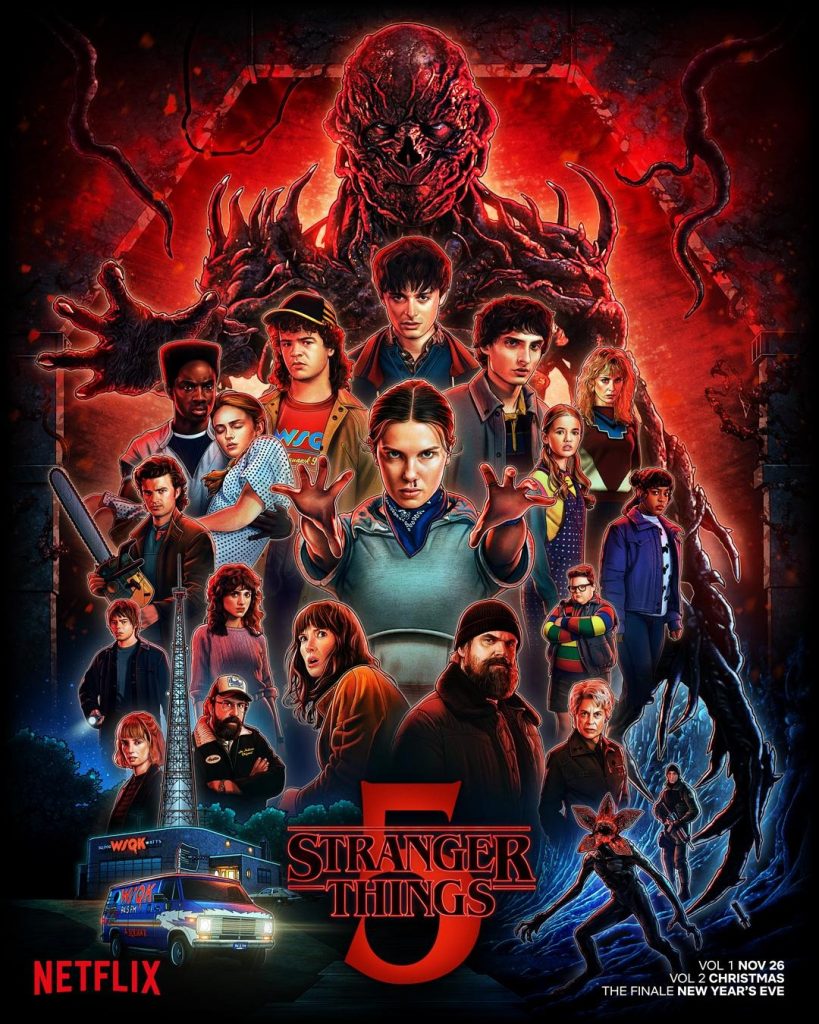
Photo Credit: Official Stranger Things S5 Poster (Netflix)
After a decade of Demogorgons, the Upside Down, and supernatural events lurking beneath the small town of Hawkins, Indiana, Stranger Things, arguably Netflix’s biggest hit series, finally came to an end on New Year’s Eve with its Season 5 series finale.
From its debut, Stranger Things, created by brothers Matt and Ross Duffer, built its reputation on a horror, mystery and sci-fi level that truly grabbed the attention of countless fans. Since 2022, fans wondered what would become of their favorite characters such as Jane Hopper/ Eleven (Millie Bobby Brown), Mike Wheeler (Finn Wolfhard), Dustin Henderson (Gaten Matarazzo), Lucas Sinclair (Caleb McLaughlin), Max Mayfield (Sadie Sink), Steve Harrington (Joe Keery), and the rest of the Hawkins crew throughout this season.
What Went Wrong??
While many longtime fans were sad to see the characters they essentially grew up with leave with closure and satisfaction for how the series ended, others walked away conflicted, arguing that the finale failed to live up to the standard set by the show’s strongest seasons. Seasons 3 and 4 in particular raised the bar, delivering high stakes, shocking twists, killing off fan favorites in gruesome ways, and introducing the series big bad, Vecna/ Henry Creel (Jamie Campbell Bower) as a terrifying threat. These elements gave fans a palpable sense that no one was truly safe.
Many were also hoping for answers to questions surrounding various plot-holes and theories that have been teased and built-up from the previous seasons. For many viewers, however, these promises were either never fully realized or seemed rushed without proper explanation.
One such heavy topic people kept talking about surrounding the finale was Will Byers’ (Noah Schnapp) coming out scene. While a huge portion of the fan-base felt this moment was long overdue for the character and was emotionally honest, others felt the moment was rather forced and was ultimately unnecessary to the larger plot, arguing that the scene, while meaningful on a personal level, slowed down the pacing during a crucial moment in the climax of the story.
Another major criticism was the show’s reluctance to raise the stakes in a meaningful way. The disconnect is especially jarring given how heavily the Duffer Brothers marketed Season 5 as the series most emotional punching and devastating season, only for the finale to pull its punches when it mattered most. Despite facing Vecna and the Mind Flayer in a final battle, with the Demogorgons being noticeably absent, the entire main cast survives the finale. This choice left fans disappointed and without the absence of a major character death, it made the outcome feel more safe and predictable.
In each of the previous seasons, Stranger Things was known to introduce new characters that the audience could resonate with and get attached to, only to kill them off in each season finale. The deaths of fan favorites, such as Bob Newby, Eddie Munson, Chrissy Cunningham, and Billy Hargrove all prove that emotional investment in these characters came with real risk. For those hoping for this same trope in Season 5 to match the show’s increasingly dark and grim tone, the lack of a major irreversible death felt like a missed opportunity to raise the stakes.
In the end, the divided response to the Stranger Things Season 5 finale highlights the challenge of concluding a massive cultural phenomenon. Whether remembered as a heartfelt goodbye or a finale that failed to live up to expectations, the talk around Stranger Things will linger long after the Upside Down fades to nothing.